Justus Jonas
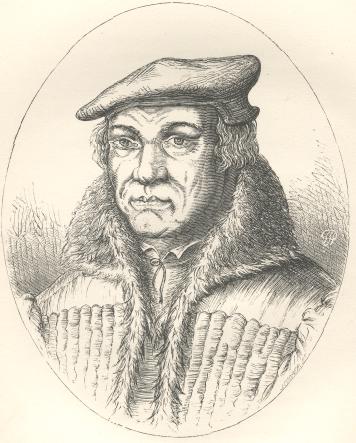 Justus Jonas -- P. 115 |
Among the friends enlisted by Luther as writers for the new hymn-books, the principal were Justus Jonas, who was for many years his colleague in the professorship of theology at Wittenberg; and Paul Eber, who stood in a similar relation to Melancthon. Melancthon himself wrote no hymns, for the one or two often attributed to him are really passages from his writings versified by friends. His work lay in the scholarship which produced what was long the standard edition in Germany of the Greek Testament, and in the theology that gave shape to the Confession of Augsburg. Justus Jonas was the son of the burgomaster of Nordhausen, a clever young lawyer, who very early became professor of jurisprudence at Erfurt 116 and a friend of Erasmus and Luther. So close was his intimacy with the latter, that he accompanied him to Worms, an act for which he was deprived of his salary as professor. Luther then induced him to study divinity and take orders, and for many years the two men lived in constant association at Wittenberg; Justus Jonas accompanied his friend on his last journey, stood by his death-bed, and with many tears preached his funeral sermon. Luther's death was followed, as he had himself foretold, by troubles and strife. For six years (from 1546 to 1552) Germany was distracted by a civil war, of which the object was to obtain toleration for the reformed doctrine, an end achieved at last by Maurice of Saxony, in the treaty of Passau. Nor was this the only struggle that was going on. Differences of opinion on intricate theological questions had already begun to divide the Reformers themselves. Various sects arose, but the chief division was that between the followers of Luther who adhered to the Confession of Augsburg, and those of Zwinglius who adopted the more Calvinistic views of the Swiss reformers, with a lower sacramental theory. These called themselves distinctively the Reformed Church, while the Lutherans adopted the name of the Evangelical Church; but the latter were by far the most numerous body, and occupied in most States the position of the National Protestant Church of Germany, while the Reformed Church took up that of an important and tolerated sect. Justus Jonas, who was not merely a good theologian, but a skilful jurist, naturally had to take part in all the many discussions and conferences in which the evangelical doctrine gradually 117 assumed definite form and consistency, and the legal and political rights of its adherents were ascertained and asserted; and of course he had to bear his share of the difficulties in which he was thus involved. On one occasion a Spanish officer quartered in his house received a large bribe to assassinate him, but was so much impressed by the piety, integrity, and kindness of his intended victim, that he confessed his purpose to him, and entreated forgiveness. Yet on his deathbed this well-proved servant of Christ suffered much from mental doubts and conflicts, until at last peace returned, and he fell asleep "as a tired soldier." What he did for hymnology was to help Luther in preparing metrical German versions of the Psalms, choosing by preference, as one can well understand, those which speak of David's sufferings from his enemies, and his trust in God's deliverance. Some of these are very celebrated, especially the one here given:--