Nathan Bangs
American Methodist theologian
Page loading...
Summary
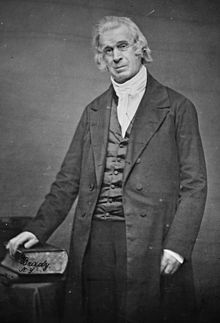
Nathan Bangs, (May 2, 1778 – May 3, 1862) was an American Christian theologian in the Methodist tradition. Born in Stratford, Connecticut, he received a limited education, taught school, and in 1799 went to Upper Canada in search of work as either a teacher or a land-surveyor. He was converted to Methodism in 1800 and worked for eight years as an itinerant preacher in the wilderness of the Canadian provinces serving communities in the areas of Kingston, York, London, Niagara, and Montreal.
Biography
Born in Stratford, Connecticut, Bangs received a limited education, taught school, and in 1799 went to Upper Canada in search of work as either a teacher or a land-surveyor. He was converted to Methodism in 1800 and worked for eight years as an itinerant preacher in the wilderness of the Canadian provinces serving communities in the areas of Kingston, York, London, Niagara, and Montreal.
Bangs was the principal founder and secretary of the Methodist missionary society. When appointed secretary of the missionary society in 1836, he devoted his chief energies to its service, until appointed president of the Wesleyan University, at Middletown, Connecticut, in 1841. Surprisingly, that proved to be a disappointment to everyone and in 1842 Bangs resumed pastoral work in New York, and in 1852 retired and employed himself during his remaining years chiefly in literary labors. Although his career was an illustrious one, Bangs's reputation suffered badly when he failed to support Methodist abolitionists at the General Conference of 1844. Abel Stevens published a lengthy biography of Bangs one year after his death in 1862.
Bangs defended Arminianism against the Calvinism of his day. He was a strong believer of prevenient grace but not at the expense of total depravity. He argued that because of grace, humankind does have the ability to respond to God. He also opposed the anti-nomianism practiced by some rival members of the New Light Baptist community.
His most important work was a History of the Methodist Episcopal Church from its Origin in 1776 to the General Conference of 1840 (4 vols., New York, 1839-'42).
Works by Nathan Bangs
Nathan Bangs, a preacher and theologian, wrote a four-volume history of the Methodist Episcopal Church that covered virtually all of the church’s proceedings in North America from 1766 to 1840. This index contains the names of all the preachers ordained by the church during those years. Bangs includes the date on which each pastor entered the ministry, then lists the date each left the ministry, most of the time on account of death. With hundreds of names listed, Americans and Canadians alive today may find the names of their ancestors.
Perhaps no one was better suited to provide a written history of the Methodist Episcopal Church than Nathan Bangs. The brilliant, self-educated theologian had not only served as president of Wesleyan University, but he had also volunteered himself as an itinerant preacher in Canada during the War of 1812. Later, he founded the Methodist Missionary Society. Volume One of Bangs’ four-volume history serves as a preface of sorts for his more detailed survey of 18th and 19th century Methodism in North America. He documents the life of John Wesley, whose lifetime overlapped with his own, then traces the spread and development of Methodism in Canada and the United States.
Perhaps no one was better suited to provide a written history of the Methodist Episcopal Church than Nathan Bangs. The brilliant, self-educated theologian had not only served as president of Wesleyan University, but he had also volunteered himself as an itinerant preacher in Canada during a time of war. Later, he founded the Methodist Missionary Society. The second volume of Bangs’ four-volume history covers the proceedings of the first few General Conferences of the Methodist Episcopal in North America as well as the events of the revivalist camp meetings at the turn of the 19th century. Bangs closes the volume with the Methodist Episcopal Church’s response to the War of 1812 and the simultaneous decline and death of one of the church’s first bishops, Bishop Asbury.
Perhaps no one was better suited to provide a written history of the Methodist Episcopal Church than Nathan Bangs. The brilliant, self-educated theologian had not only served as president of Wesleyan University, but he had also volunteered himself as an itinerant preacher in Canada during a time of war. Later, he founded the Methodist Missionary Society. The third volume of Bangs’ History picks up where the last left off, at the end of the War of 1812. With the Methodist church growing and gaining notoriety, controversies over theology and practice enabled it to better define itself. Bangs includes the names and proceedings of the General Conferences during this time (1816-1828).
Perhaps no one was better suited to provide a written history of the Methodist Episcopal Church than Nathan Bangs. The brilliant, self-educated theologian had not only served as president of Wesleyan University, but he had also volunteered himself as an itinerant preacher in Canada during the War of 1812. Later, he founded the Methodist Missionary Society. The final volume of Bangs’ four-volume history carries the proceedings of the Methodist church up to the 1840s, just decades before the American Civil War. During this time, the church formulated its views on the North American slave trade, becoming a force in favor of abolition. Bangs’ detailed documentation of church proceedings and projects in this volume and those before it provides church historians with an invaluable resource.
Popularity is calculated by comparing this book's number of views to our most commonly read book. Popularity is calculated by comparing this book's number of editions to the book with the largest number of editions.